ISO 14001 certification is the world’s most widely adopted standard for environmental management systems (EMS).
Whether driven by supply-chain requirements, regulatory pressure, or genuine commitment to sustainability, organizations that implement ISO 14001 consistently gain a measurable competitive edge — in cost savings, market access, and stakeholder trust.
Why Environmental Credibility Is No Longer Optional
Here’s a scenario that plays out every week in procurement departments around the world:
A perfectly qualified supplier submits a competitive bid. The pricing is sharp, the references are solid, and the delivery timeline works.
But there’s a checkbox near the bottom of the RFP that reads: “Does your organization hold current ISO 14001 certification?”
The box goes unticked. The bid goes in the pile marked “maybe later.”
If that’s happened to you — or if you’ve been watching it happen to businesses in your industry — you already understand why environmental management isn’t a fringe concern anymore. It’s a boardroom priority, a supply-chain requirement, and increasingly, a deal-breaker.
The challenge? ISO standards documentation reads like it was written by lawyers raised by accountants.
Most business owners hear “ISO 14001 environmental management system” and immediately zone out.
This guide fixes that.
We’ll walk through exactly what ISO 14001 is, what it costs, how the certification process works, and — critically — whether it’s worth the investment for your organization. No consulting-firm jargon. No 47-page white papers. Just practical, honest guidance from the Sustaenia team.
What Is ISO 14001?
ISO 14001 is an internationally recognized standard that gives organizations a structured framework for managing their environmental impact.
It’s published by the International Organization for Standardization (ISO) — the same body behind quality management (ISO 9001), information security (ISO 27001), and dozens of other frameworks used across every industry.
At its core, the standard asks one big question: Does your organization have a system in place to identify, manage, monitor, and continually improve its environmental performance?
That’s it. ISO 14001 doesn’t set specific emissions thresholds or water-usage limits.
It’s a management system standard — it cares about how you handle environmental issues (processes, accountability, documentation, commitment to improvement), not whether you’ve hit a green metric on day one.
What ISO 14001 Is NOT
- It’s not a law. ISO 14001 is voluntary. No government requires it — but many private-sector contracts and public procurement processes do.
- It’s not a one-time checklist. Certification involves ongoing surveillance audits (usually annual) and full re-certification every three years.
- It’s not just for factories. Service companies, tech firms, universities, hospitals, and local governments use ISO 14001.
- It’s not the same as being “green.” The standard is about having a credible system in place — not about being a zero-waste utopia overnight.
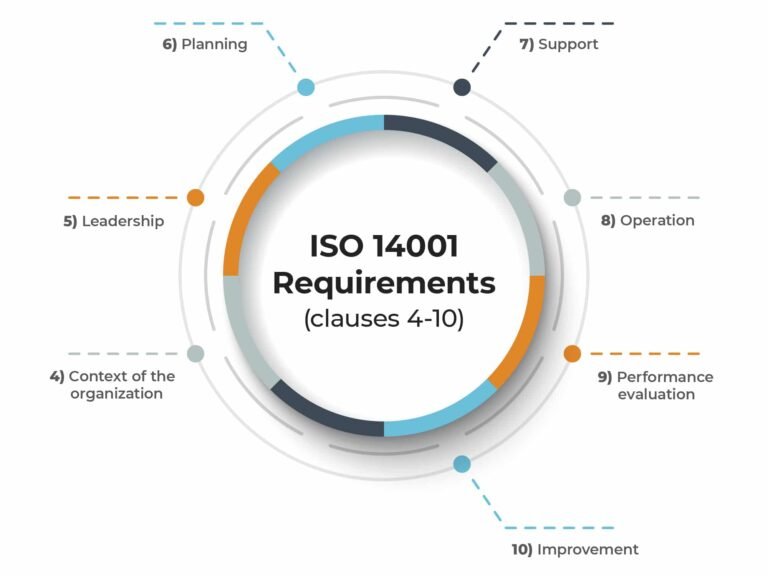
The current version is ISO 14001:2015, which introduced stronger emphasis on leadership involvement, lifecycle thinking, and risk-based planning. If you see anyone referencing the 2004 version, their material is outdated.
Key Benefits of ISO 14001 Certification
Nobody pursues ISO certification because it sounds fun. Businesses invest because the returns — strategic and operational — are tangible.
Business Benefits
- Access to new contracts and markets. Many large corporations and government agencies require ISO 14001 from suppliers. In automotive, aerospace, construction, and energy, it’s practically table stakes.
- Cost savings through waste reduction. A well-implemented EMS forces you to measure inputs and outputs. Companies routinely discover overspending on energy, water, raw materials, or waste disposal — and the fixes are often surprisingly simple.
- Regulatory risk reduction. Systematic compliance tracking means you’re far less likely to miss a permit renewal, violate a discharge limit, or get blindsided by a regulatory change.
- Stakeholder and investor confidence. ESG reporting is no longer optional for many publicly traded companies. ISO 14001 provides a recognized, audited framework that demonstrates environmental governance.
- Brand differentiation. In consumer-facing markets, environmental credentials influence purchasing decisions. Certification gives you a verifiable claim — not just marketing copy.
Environmental Benefits
- Structured pollution prevention. Identify significant environmental aspects (emissions, effluent, waste, resource consumption) and set measurable improvement objectives.
- Lifecycle thinking. The 2015 revision pushed organizations to consider impact across the full product or service lifecycle — from raw material sourcing through end-of-life.
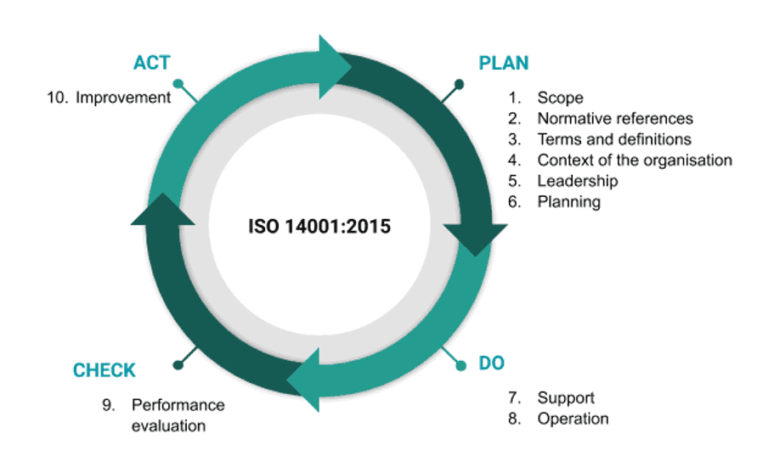
- Continuous improvement culture. The PDCA (Plan-Do-Check-Act) cycle ensures you’re always iterating and finding the next opportunity to reduce impact.
Key insight The benefits of an ISO 14001 environmental management system tend to compound over time. Year one is about building the system. Years two and three are where operational savings and strategic advantages really accumulate.
How to Get ISO 14001 Certified: Step-by-Step Process
This is where most guides either oversimplify or drown you in consultant-speak. Here’s the practical middle ground — enough detail to plan your project, without the jargon.
1. Get Leadership Buy-In (and Mean It)
ISO 14001:2015 explicitly requires “top management” to demonstrate leadership and commitment.
Auditors will interview senior leaders and expect them to articulate how environmental management integrates with business strategy.
If your C-suite treats this as a “compliance department problem,” you’re setting yourself up for a painful audit.
2. Define Your Scope and Context
Clearly define which parts of your organization, locations, and activities the EMS will cover.
Identify interested parties (regulators, customers, community groups, investors) and their environmental expectations.
This “context of the organization” analysis sets the boundaries for everything that follows.
3. Conduct an Initial Environmental Review
Identify all environmental aspects (energy use, emissions, water consumption, chemical storage, waste generation), evaluate which are “significant,” and map your compliance obligations.
Many organizations use environmental management software to streamline data collection and keep everything auditable from day one.
4. Build Your EMS Documentation
The standard requires documented information — an environmental policy, objectives, procedures, and records.
The 2015 version offers more flexibility in how you document, but you still need clear, accessible documentation that people actually use.
5. Implement Operational Controls and Training
Train employees on their environmental responsibilities, establish operational controls for significant aspects (spill prevention, waste segregation, energy management), and ensure emergency preparedness procedures are in place.
Providers like Udemy’s ISO 14001 training courses can bring staff up to speed without expensive in-person workshops.
6. Run Internal Audits and Management Review
Before any external auditor visits, audit yourself. Internal audits check whether the EMS works as designed and catch nonconformities early.
Follow with a formal management review where leadership evaluates performance, resources, and improvement opportunities.
Dedicated audit management software helps track findings, corrective actions, and evidence in one place.
7. Select a Certification Body and Complete the External Audit
Engage an accredited certification body (registrar) for your external audit.
Stage 1 reviews your documentation.
Stage 2 verifies implementation through interviews, observations, and records. Pass both stages and you receive your ISO 14001 certificate — valid for three years with annual surveillance audits.
Pro tip Look for a certification body accredited by a national accreditation body (ANAB in the U.S., UKAS in the UK). Get at least three quotes — prices vary significantly. And be wary of any registrar that also offers to build your EMS. That’s a conflict of interest that violates accreditation rules.
ISO 14001 Certification Cost: Realistic Expectations
Let’s address the question everyone Googles but few articles answer honestly: how much does ISO 14001 certification actually cost?
| Cost Component | Small Business (10–50 employees) | Mid-Size (50–250 employees) |
|---|---|---|
| Consulting / Gap Analysis | $3,000 – $8,000 | $8,000 – $25,000 |
| Training (Lead Auditor, Awareness) | $1,000 – $3,000 | $3,000 – $8,000 |
| Software / Documentation Tools | $500 – $2,000/yr | $2,000 – $8,000/yr |
| Certification Audit (Stage 1 + 2) | $3,000 – $6,000 | $6,000 – $15,000 |
| Annual Surveillance Audits | $1,500 – $3,000/yr | $3,000 – $7,000/yr |
| Total First-Year Estimate | $8,000 – $20,000 | $22,000 – $60,000+ |
ISO 14001 Certification Cost for Small Businesses
The ISO 14001 certification cost for small businesses typically falls in the $8,000–$20,000 range for the first year.
A significant chunk is one-time setup (consulting, documentation, training). Ongoing annual costs for surveillance audits and software are considerably lower.
There are ways to manage costs intelligently. Some organizations build the EMS internally using toolkits and templates.
Platforms like Advisera’s ISO 14001 documentation toolkit offer pre-built templates and step-by-step guidance at a fraction of consultant fees.
What About the Timeline?
For most organizations, expect 6 to 18 months from kickoff to certification.
The biggest variables: your starting maturity and the availability of internal resources.
Companies that dedicate a project manager and real working hours finish in 6–10 months. Those treating it as a side project can easily take 18+ months.
Budget honestly The hidden cost most businesses underestimate is internal staff time. Even with a consultant, someone on your team needs to drive the project — attend meetings, review documents, coordinate training, and prepare for audits. Budget 8–15 hours per week during active implementation.
The Criticism: Is ISO 14001 Just Greenwashing With a Certificate?
We’d be doing you a disservice if we pretended ISO 14001 is universally beloved. It isn’t. The criticisms deserve honest engagement.
“It Doesn’t Require Actual Environmental Improvement”
This is the most common — and most legitimate — criticism.
Because ISO 14001 is a management system standard rather than a performance standard, an organization can theoretically maintain certification while continuing to pollute, as long as it has a system for managing that pollution and a commitment to improvement.
Critics argue process can substitute for outcomes.
The counterargument: the standard does require continual improvement of the EMS and environmental performance. But “continual improvement” is relative.
A cement plant improving energy intensity by 2% per year meets the standard, even if absolute emissions remain enormous. Whether that’s sufficient is a values question, not an audit question.
“It’s Pay-to-Play Credentialing”
Some view the entire ISO certification ecosystem — standards bodies, registrars, consultants, training providers — as a self-reinforcing industry profiting from complexity.
There’s some truth to the observation: the market is worth billions globally. The question is whether value delivered justifies the cost. For many organizations, it does.
For very small businesses with minimal environmental impact and no supply-chain pressure, the ROI may not be there — and that’s a legitimate conclusion, not a failure.
“It’s Bureaucratic and Paper-Heavy”
This criticism applied more strongly to the 2004 version. The 2015 revision deliberately reduced prescriptive documentation requirements.
That said, any management system standard involves paperwork.
The question is whether you design a system that serves your business or one that serves the auditor — good implementations prioritize the former.
So Is It Worth It?
Our honest take: ISO 14001 is a powerful tool, but it’s only as good as the intent behind it.
Organizations pursuing certification as a box-ticking exercise will get box-ticking results.
Organizations using the framework to genuinely embed environmental thinking into operations will see real, measurable returns. The standard is a vehicle, not a destination.
Who Needs ISO 14001? Real-World Examples
ISO 14001 isn’t confined to heavy industry. The breadth of certified organizations might surprise you.
Manufacturing and Heavy Industry
Automotive manufacturers, chemical producers, mining companies, and food processors face significant compliance obligations.
For these industries, certification is often a condition of doing business with major OEMs and Tier 1 suppliers.
Companies like Toyota, Siemens, and Nestlé require EMS certification throughout their supply chains.
Construction and Engineering
Large infrastructure projects — particularly public-sector contracts — increasingly require ISO 14001 from contractors.
Managing site waste, emissions, noise, and water runoff under a certified framework demonstrates due diligence.
Technology and Professional Services
Even companies whose “environmental impact” is mostly energy consumption and e-waste.
Data center operators, IT service providers, and consulting firms pursue certification to meet client expectations, support ESG reporting, and manage their carbon footprint methodically.
Small and Medium Enterprises (SMEs)
SMEs face a cost-benefit dilemma. If your customers or procurement partners require certification, the ROI calculation is straightforward.
If you’re a local service business with no supply-chain pressure, tracking environmental performance informally using the ISO 14001 framework can still deliver operational value without the certification cost.
For business owners exploring this middle ground, BSI’s ISO 14001 resource hub offers free guides and readiness assessments.
Public Sector and Education
Universities, hospitals, and municipal governments are among the fastest-growing segments for ISO 14001 adoption.
These organizations face public accountability and benefit from the structured approach the standard provides.
How Sustaenia Can Help
Sustaenia provides end-to-end ISO 14001 support — from gap analysis and EMS design through documentation, internal audit preparation, and certification readiness.
Our team combines deep expertise in environmental management with practical experience across manufacturing, services, and technology sectors. Explore Our Certification Services